On fiscal-hardware vendor sites the set is usually called a “till with a terminal.” One box, one contract, one installment. The kit looks as if the tax office required it and is often sold that way, because almost everyone who opens a workshop, a practice or a salon asks “do I even have to have this.”
The answer sits in two statutes that regulate two entirely different things: recording the sale and taking a cashless payment. Mixing them up costs concrete money, usually on the side of the person asking.
Fiscal till versus payment terminal: two statutes, two duties
The till duty follows from Art. 111 of the VAT Act, and its scope is set by the Minister of Finance regulation of 17 December 2024 (Journal of Laws 2024 item 1902), in force from 1 January 2025 to 31 December 2027. General rule: on sales to natural persons not running a business and flat-rate farmers the till enters after exceeding PLN 20,000 of annual turnover, counted proportionally if the firm started mid-year.
The cashless duty is a different provision — Art. 19a(1) of the Entrepreneurs’ Law. The entrepreneur “ensures the possibility of making payment in every place where business activity is actually performed (…) using a payment instrument.”
That sentence does not contain the word “terminal.” The Payment Services Act defines a payment instrument as an individualized device or an agreed set of procedures for placing a payment order — a category much broader than one device on the counter.
More important, though, is paragraph 2 of the same article, because it sets the whole dependency: those without a till-recording duty are exempt from the cashless duty. The order is one-way — first the till topic is settled, and the duty to take cashless payments is its derivative. Merely having a terminal neither triggers nor lifts the fiscal duty; the only exception where the form of payment matters at all I describe later in the text.
The sanction for lacking a cashless payment option is not a fine but loss of the 25-day VAT refund for seven settlement periods and a switch from quarterly to monthly settlement. That hurts liquidity, though it is a different category from a till inspection.
Fourteen kinds of services where a till is mandatory from the first zloty
The PLN 20,000 limit has an exception that in practice decides everything: § 4 of the regulation. The services listed there do not benefit from exemptions at all — a till is needed from the first transaction, regardless of turnover and of whether the customer pays cash, card, BLIK or transfer.
The list in § 4(1)(2) covers: passenger transport in road communication, taxis, repair of motor vehicles and mopeds, tyre and wheel replacement, vehicle technical inspections, medical care by doctors and dentists, legal services, tax advice, food service and catering, hairdressing, cosmetic and cosmetology services, circus performances, entry to amusement parks and discos, and car washing and cleaning. From 1 April 2026 parking services were added, and from 1 April 2027 services provided via machines, including ticket machines, will join — then the list grows to fifteen items.
A separate list in § 4(1)(1) excludes supplies of certain goods from exemptions. If next to the service you sell products — parts, car cosmetics, preparations — check that list too.
Worth looking at that list once more. Each item describes a type of activity — the regulation does not mention the form of payment with a single word here. The till duty was assigned to what you sell, not to what the customer pays with. The whole rest of thinking about till and terminal rests on that distinction.
The consequence for service micro-firms is two-sided. A workshop, car wash, hair salon and beauty practice have a till from the first zloty and changing how payments are taken will not move that. But installation, on-site service, cleaning, training or construction services do not appear on the § 4 list — there the PLN 20,000 limit works normally.
A till need not be a “metal box”: the rules allow tills in software form, and a 2025 amendment (Journal of Laws 2025 item 1345) added machines, ticket machines and parking to the catalogue of eligible industries. The catalogue stays narrow — hairdressing, cosmetics and vehicle repair are not in it.
Terminals in Poland are growing; firms with a terminal are shrinking
Move from the statute to the market, because NBP data show something the statute alone does not.
At end-March 2026 Poland had 1.412 million payment terminals. The figure alone says nothing, so a reference at once: in December 2024 there were 1.375 million. Devices grew by 37 thousand, or 2.7% in fifteen months.
And now the counter-figure from the same NBP statistics. Firms using terminals numbered in December 2024 626,572, and in March 2026 — 578,200. They fell by 48 thousand, or 7.7%. Card-accepting retail and service points were 974,100 and became 888,800 — minus 85 thousand, minus 8.8%.
The gap is not new. “There are more and more POS terminals in Poland where you can pay by card; the number of firms that accept card payments is falling,” Cashless noted already on the previous edition of these statistics in April 2025, pointing to two causes: consolidation of retail chains densifying devices at their own sites, and smaller firms closing.
The first cause the data confirm: one firm with a terminal now has 2.44 devices versus 2.19 in December 2024. The second is harder to defend, because GUS counts differently: in Q2 2026 active enterprises numbered 2,896,481, up 1.6% year on year, and the entire positive result came from micro-firms — 2,779,281 entities, 96% of the market, while small, medium and large classes shrank. Firms in Poland are growing. Firms with a terminal are shrinking.
And if you took only transfers?
There is one exception to that rule and it accounts for most misunderstandings — because in it the form of payment does matter.
Item 37 of the annex to the regulation exempts from the till services for natural persons if the provider receives the whole payment via post, bank or credit union to their account, and the records and payment proofs show which act the inflow concerned.
That exemption has two hooks and both are sharp. First: it does not work for § 4 services. A hairdresser can take only transfers for ten years and must still have a till. Second: the “in full” condition means exactly what it says — taking cash lifts the exemption for that sale, and authorities interpret the condition strictly, so a single cash inflow can decide the duty. Card or BLIK payment is treated as a cashless payment to the account, but the recording duty assigning the inflow to a concrete service remains. At one transfer a day that is a formality. At dozens of micropayments — daily work.
The bill for a kit whose half did not have to be in the kit
Let us count what a choice made on the wrong question costs.
On the till side: simple models today cost PLN 1,000–1,500, fiscalization usually about PLN 300, mandatory review every two years — PLN 150–300. The Art. 111(4) VAT Act relief refunds 90% of net price, max PLN 700. For a PLN 1,200 till real entry cost falls to around PLN 800 with fiscalization, plus about a hundred a year for reviews.
On the terminal side the bill is more scattered. Public price lists of acquiring agents break it into lease, service, SIM card, printouts and reports — each item in the PLN 5–20 a month range — plus commission and an installation fee. Items are so small nobody sums them: at three of those, about PLN 30 a month together, a two-year contract gives PLN 720 of device handling alone, before turnover commission.
Separately worth checking what “a free terminal” means. The Polska Bezgotówkowa programme is real, but operator materials describe it differently: some speak of 12 months without fees and a PLN 100,000 turnover limit, others of 5 months and a PLN 42,000 threshold. Terms have changed over time, so only the terms attached to the contract give a binding answer.
And one more argument that has already gone out of date. The duty to technically link an online till with a terminal, written in Art. 19a(3) of the Entrepreneurs’ Law and backed by a fine up to PLN 5,000, was repealed by the Act of 24 January 2025 and has not applied since 1 April 2025. Instead of hardware integration, acquiring agents report transaction data straight to KAS. Whoever today justifies buying a kit by the need for integration cites a provision that has not existed for a year and a half.
Where in all this is QR-code payment?
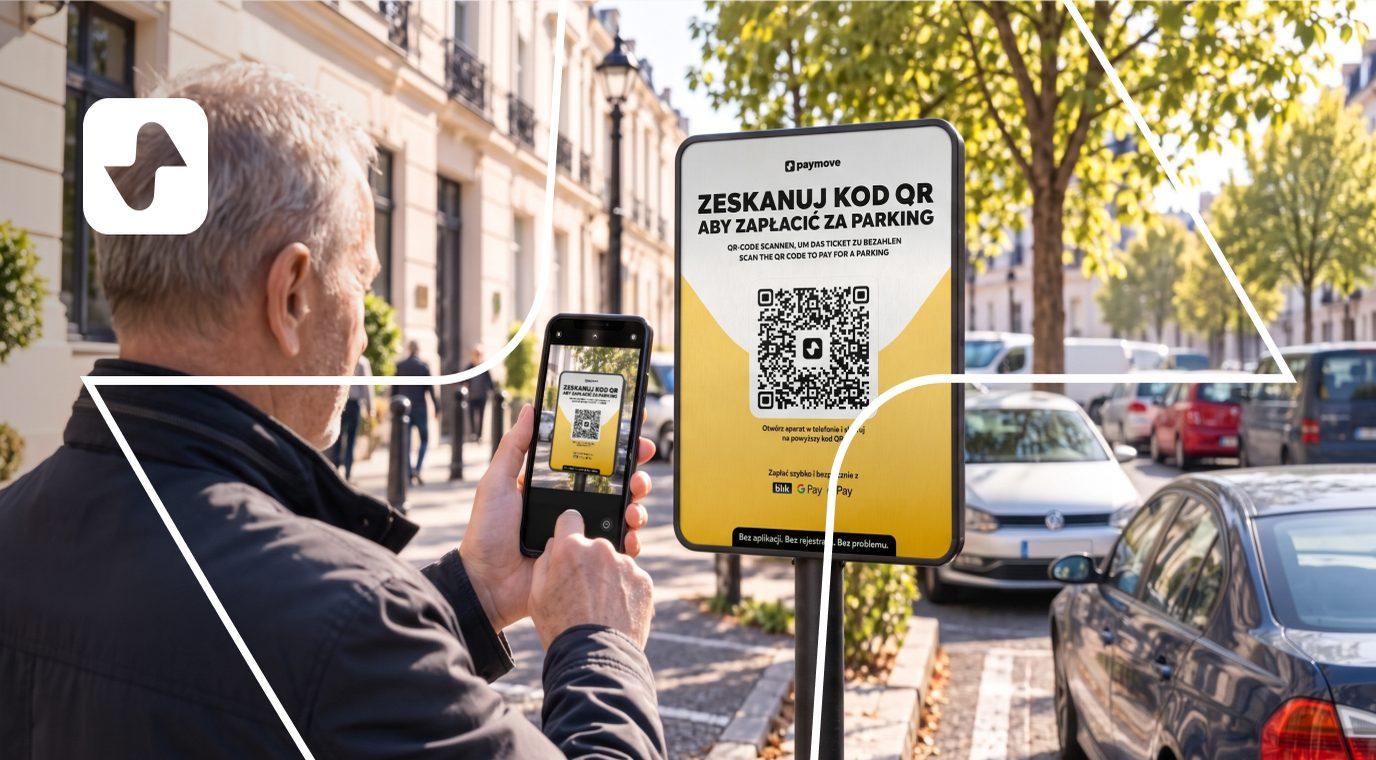
Without this fragment the text would be a diagnosis without consequence. Paymove handles the payment: the customer scans a code and pays with BLIK, Apple Pay or Google Pay from their phone, without installing an app, and the entrepreneur neither buys nor leases a device. In Art. 19a categories that is a payment instrument — as much as the provision requires.
What we will not pretend: it does not touch the fiscal duty in the slightest. The till and receipt stay on the entrepreneur’s side, exactly as with a terminal and with cash. Detailing, car wash, workshop, hair salon and beauty practice — a large part of firms asking about payment without a terminal — have a mandatory till from the first zloty. Whoever promises otherwise is selling an interpretation that is not in the regulation.
Five questions before signing a contract
- Is my service in § 4(1)(2) of the regulation? If yes — till from the first zloty, the PLN 20,000 limit does not apply and there is nothing to discuss.
- If not — what was my turnover for natural persons last year? Below PLN 20,000 there is no till duty, and with it the Art. 19a(2) duty falls away. After exceeding the limit the exemption loses force two months after the month of exceedance (§ 5 of the regulation).
- Do I take even one cash payment? Item 37 exemption is lifted by one such transaction, so the condition must be assessed realistically.
- What is the sum of items in the terminal contract over its whole term? Count them all: lease, service, SIM, reports, early-termination fee and commission.
- To meet Art. 19a do I need a device specifically? The provision speaks of a payment instrument, and a terminal is one of the forms that can fulfil that requirement.
On doubt about the first point an accounting office or an individual interpretation wins. Service classification can be contested — authorities have argued over the scope of “cosmetic services,” for example — and this text describes the state of the rules and does not replace a ruling in a concrete case.